
A garage door is off track when one or more rollers no longer travel inside the intended track channel, or when the door and track have shifted enough that normal controlled movement is no longer possible. The safest response is to stop operation, keep the opening clear and have the door secured before anyone tries to move it.
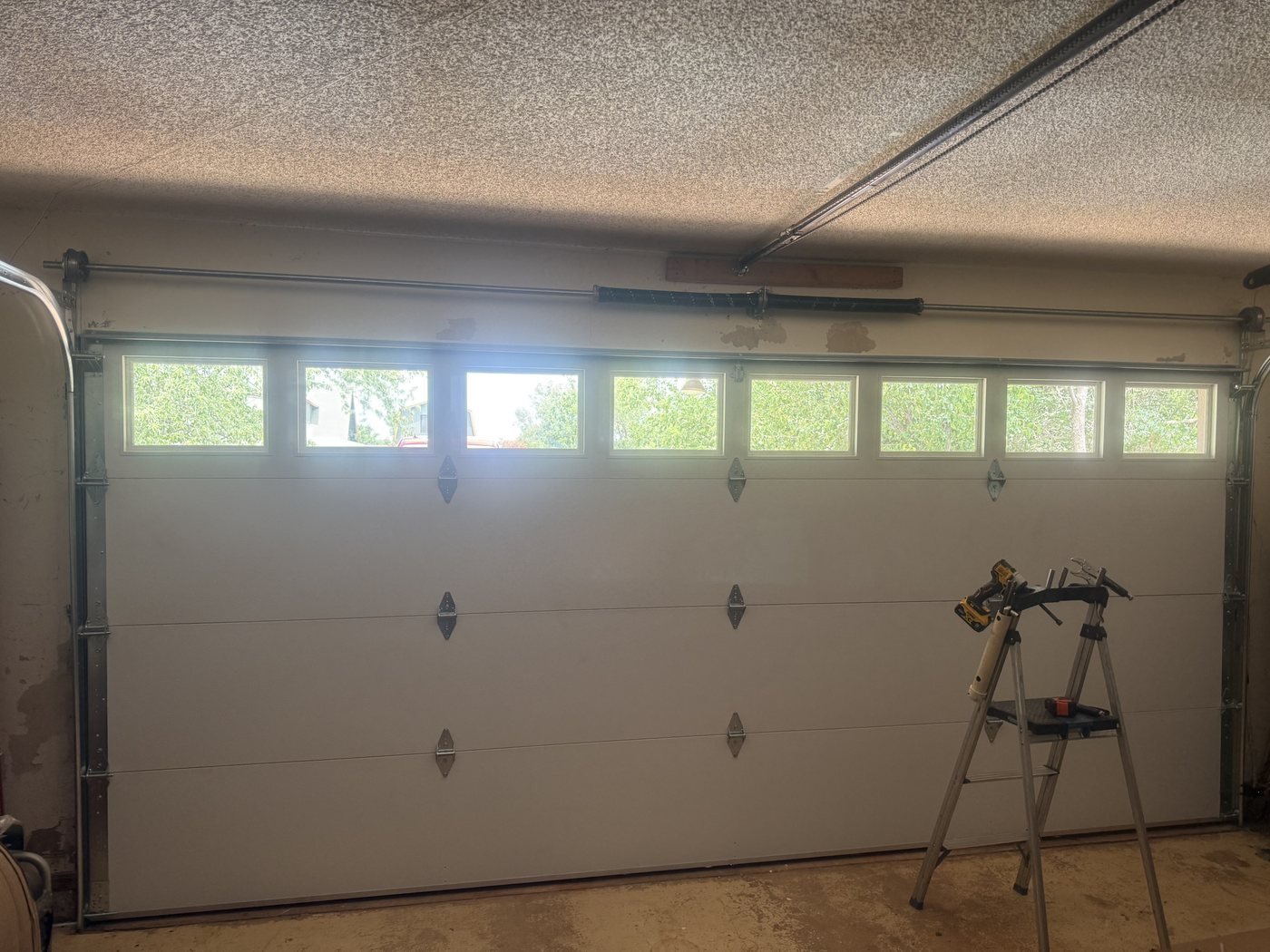
Visible conditions that should end further operation
An unusual sound by itself does not prove that a roller has left the track. Look at the complete opening from outside the travel path and stop if any of these conditions are visible:
- One roller sits outside the track channel or a roller stem no longer lines up with the other hinges.
- The door is tilted, one bottom corner is lower, or the gaps beside the opening have changed sharply.
- A vertical or horizontal track is bent, separated from its supports or pulled away from the wall.
- A lift cable is loose, hanging, frayed or no longer follows the same path as the cable on the opposite side.
- A section edge, hinge or bracket is folded, torn or pulling away from the door.
- The door is stuck partly open, shaking, scraping or moving one side at a time.
Do not press the remote again to see whether the condition clears. Powered movement can pull a displaced roller farther from the track, distort section edges, change cable tension or load the opener against a door that cannot follow its normal path.
Why putting the roller back is not the complete repair
A roller can leave the track after impact, track movement, hinge failure, roller wear, cable displacement, loss of spring support or uneven resistance elsewhere in the door. The roller position is the visible result; it does not identify the first failed component. Returning a roller to a damaged or misaligned track without correcting the cause can leave the door ready to derail again.
The inspection should compare both sides of the opening. A problem near one roller may be connected to a cable or drum condition on the opposite side, a bent lower section, track spacing that changed, or a door that no longer carries its weight evenly. Springs, cables, drums and bottom fixtures should not be loosened as part of a homeowner check.
Information to record from a safe distance
- State whether the door is fully closed, partly open, fully open or visibly tilted.
- Describe which side appears displaced and whether a roller is visibly outside the track.
- Note the last control used and where movement changed, without operating the door again.
- Record any recent vehicle impact, object in the opening or change in sound and movement.
- Take a wide photo of the complete door and safe side views of the tracks without standing beneath the door.
- Explain whether the opening can be avoided and secured while service is arranged.
This information helps plan access and immediate support needs. Photos cannot show spring force, door balance, hidden fastener damage or whether a section can safely carry load, so they do not replace an on-site evaluation.
What a professional off-track inspection should cover
- Restrict the work area and support the door before attempting movement.
- Confirm the position of every roller and the condition of each hinge and section edge.
- Measure vertical and horizontal track alignment, spacing, attachment and visible impact damage.
- Inspect cables, drums, bottom fixtures, shaft hardware and spring support for uneven loading.
- Check the opener rail, trolley, arm and top-section attachment for strain caused by attempted operation.
- Identify the likely sequence that displaced the door instead of treating the roller position alone.
- After approved repairs, verify controlled manual travel and balance before reconnecting and testing the opener.
- Confirm travel limits, photo-eye response and automatic reversal according to the installed opener instructions.
The Door & Access Systems Manufacturers Association notes that a door prepared for automatic operation should move freely and keep its rollers in the tracks. Its operator safety FAQ also emphasizes checking the door and hardware before relying on the opener.
Repair or replacement depends on the remaining structure
A focused repair may be possible when the door can be secured, the track and roller hardware can be restored to specification, compatible parts are available and the sections remain structurally usable. A broader repair or replacement comparison may be needed when impact has folded section edges, torn hinge attachments, bent multiple tracks or created damage across several connected components.
Ronnie’s provides off-track garage door repair in Boulder and nearby communities during posted daily hours. The service decision is made after the complete track, roller, cable, spring, panel and opener system is evaluated, not from a single photo or symptom.
Can I close an off-track garage door by hand?
Do not push or pull a crooked, partly open or unsupported door. It can shift as the rollers, cables and sections change position. Keep the travel area clear and have the door secured before movement is attempted.
Does pulling the emergency release make the door safe?
No. The release separates the opener connection; it does not remove door weight, spring force or instability. Pulling it while the door is open or uneven can allow uncontrolled movement.
Can only one roller be replaced?
Possibly, but the cause still needs to be identified. Track damage, hinge wear, section damage, cable imbalance or another roller may have contributed to the displacement.
When is panel or full-door replacement considered?
Replacement becomes part of the comparison when section edges, hinge attachment areas or multiple components cannot safely support normal travel, or when compatible repair parts are unavailable.