
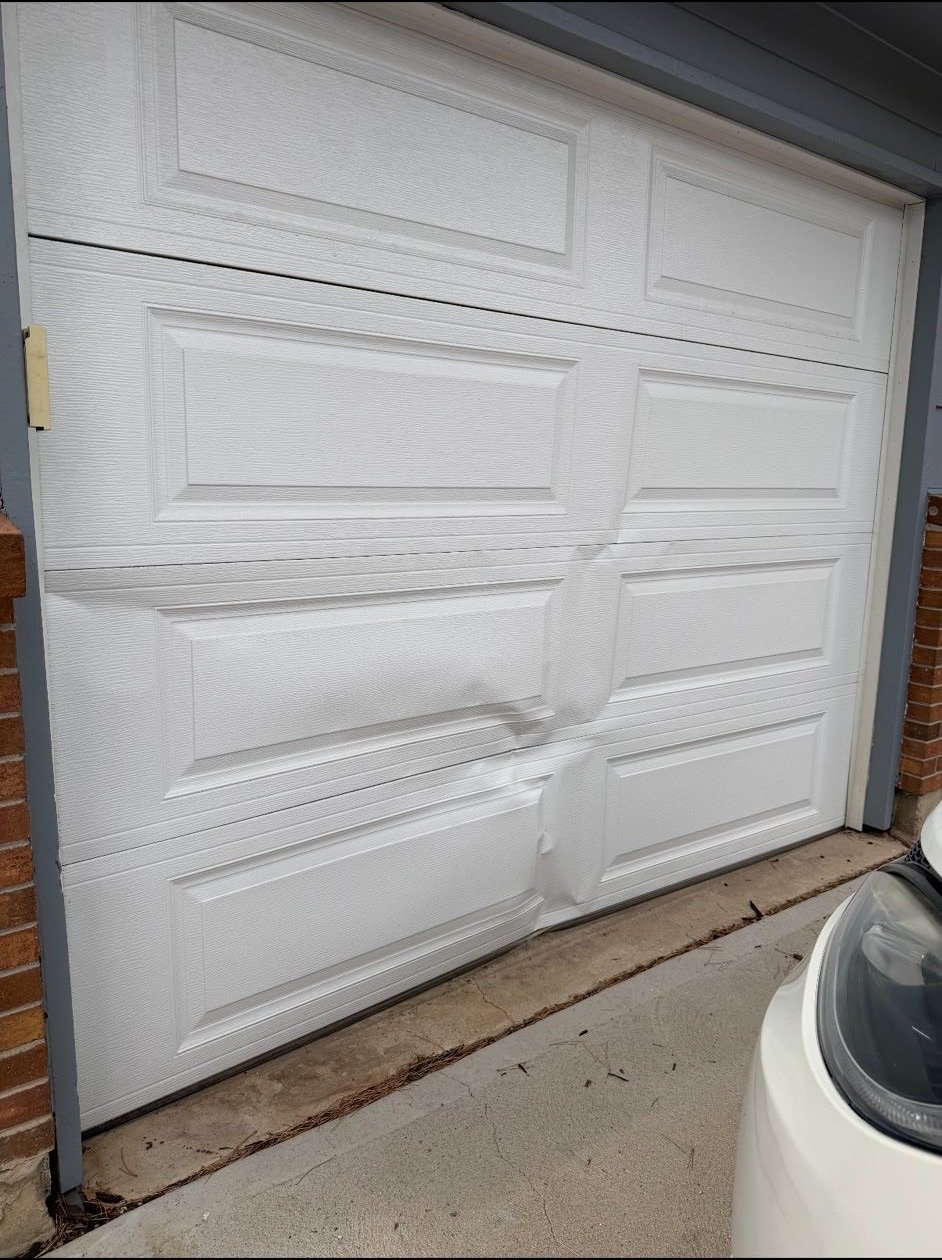
This owner-confirmed Lyons project photo shows deep creases running across several sections of a white raised-panel garage door. The visible damage makes this an impact-damage assessment case study, where safe stabilization and a panel-repair versus full-door replacement decision come before normal operation.
Why multi-section creases change the repair decision
A sectional garage door must bend at controlled joints as it moves from the vertical tracks into the horizontal tracks. The door in this photo has a deep deformation that crosses more than one section and interrupts several raised-panel shapes. Damage of that scale can affect how section edges meet, how hinges hold alignment and how the door carries force during travel.
The exterior alone cannot show whether reinforcement, hinge attachment points, rollers, tracks or cables were also affected. That is why a technician should not promise a panel-only repair from a photo. The door first needs to be placed in a stable condition and inspected from both sides without forcing it through another cycle.
Immediate safety priorities at a damaged door
- Stop repeated opener use when sections fold, rub or move unevenly.
- Keep vehicles and people clear of the travel path and the area beneath a partly open door.
- Do not try to hammer or pull the sections straight while they remain connected to loaded spring and cable hardware.
- Do not loosen hinges, bottom fixtures, cables, drums or springs as a test.
- Record whether the door can remain closed and secured until the evaluation.
Pulling the opener emergency release does not remove door weight or spring force. On an open, crooked or unsupported door it can remove the operator connection that was limiting movement. A damaged opening should be stabilized before manual movement or disassembly is considered.
What the Lyons assessment should cover
- Current door position, structural stability and immediate support needs.
- Every damaged section, including edges, joints, internal reinforcement and hinge attachment areas.
- Rollers, hinges and vertical and horizontal tracks near the deformation.
- Cables, drums, bottom fixtures, spring support and whether one side carries load differently.
- Opener rail, door arm, top-section reinforcement and any sign that powered operation added strain.
- Door identification, section dimensions and whether compatible replacement sections remain available.
- Opening measurements and system requirements if complete replacement needs to be compared.
Panel repair, section replacement or full door replacement?
A shallow cosmetic dent can create a different decision from the deep, connected creases visible here. Section replacement may be practical when damage is limited, compatible parts are available and the remaining door and hardware are structurally serviceable. Matching requires more than color: section height, thickness, profile, edge design, hinge pattern and connection points must fit the existing system.
Full replacement deserves comparison when several sections are distorted, the door no longer stays square, compatible sections are unavailable, supporting hardware is also damaged or the cost of rebuilding the old system approaches a complete door. The decision should include opener compatibility, track condition, spring sizing, seals and the owner’s longer-term goals rather than treating the visible skin as the only issue.
Because the available project record does not state which option was ultimately selected, this page does not claim that Ronnie’s replaced a panel or installed a new door. It documents the evidence a Lyons property owner should expect before approving either path. The broader panel repair or replacement guide explains the comparison in more detail.
What a final work record should contain
After the owner approves a repair or replacement, the invoice should identify the sections or complete door involved, supporting hardware changed or reused, and the checks completed before normal use. Controlled travel, balance, cable position, track clearance and secure hardware should be documented. If an opener is connected, the work record should also note travel-limit, photo-eye and automatic-reversal testing appropriate to that operator.
That documentation turns a visible-damage photo into a reliable service history. It also helps the next technician understand what was changed instead of asking the homeowner to reconstruct the event from memory.